Hawaii State Public Library System
01
2026
Taking Flight
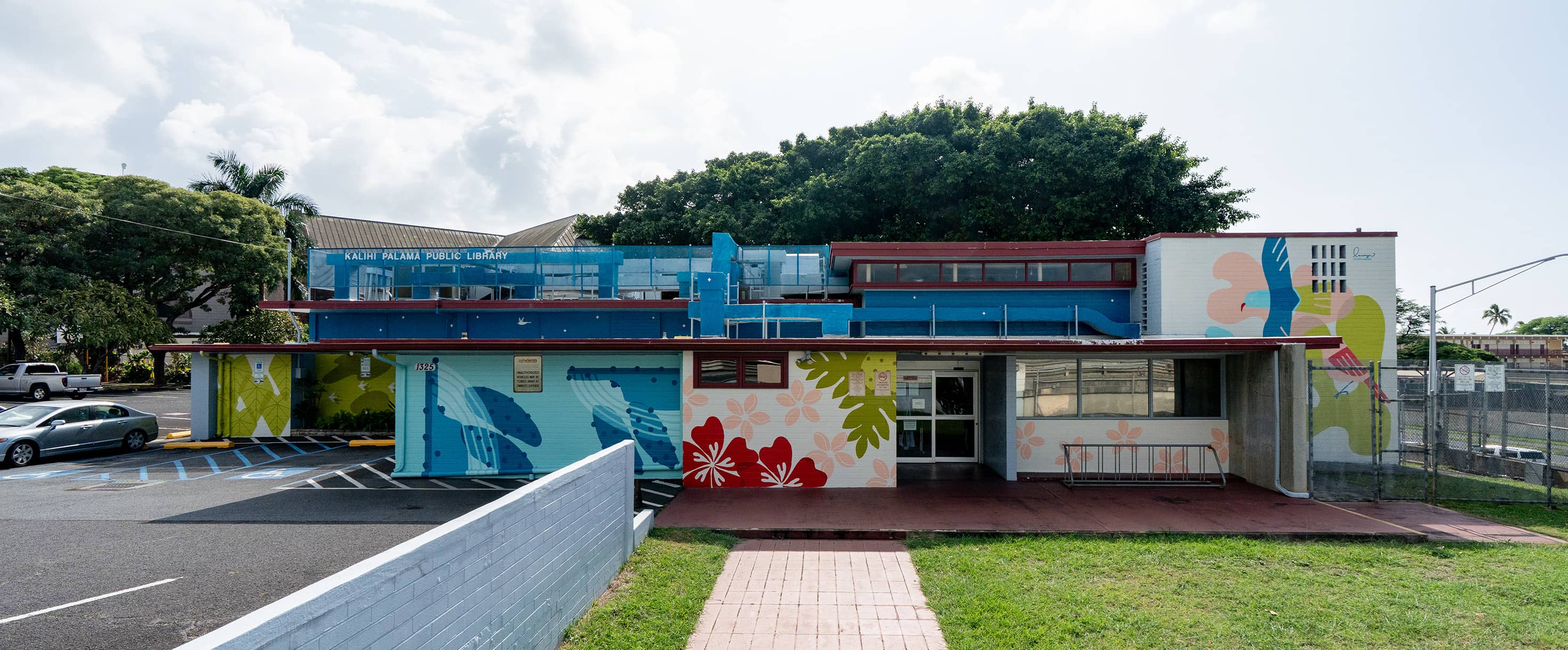
Every project presents an opportunity for me to dig into my values and how they align within the community my art lives. This mural project was no small feat and is so symbolic to the ebbs and flows of my life. Most times, the challenging walls are the most rewarding. I experienced battles with Hawaii's winter weather, textured walls, rolling around like I was in Mission Impossible — literally singing the song while getting to the air ducts, straddling holes above ground, and figuring out how to jerry-rig plywood and flooring to maneuver the lift. Still one of my favorite large-scale pieces I've done. I definitely asked myself several times, "How am I gonna do this?"
The theme of this mural symbolizes the heart of Kalihi — its often the landing pad for many immigrant communities. How do we bring what we knew and brought us comfort to an unknown place and make it home? Kalihi is no stranger to assimilation while navigating change.
Here are my thoughts and inspiration behind this mural project.
Sense of Place
Kalihi
Kalihi was a nutrient-rich ahupuaʻa serving a diverse community of eager immigrants diligently working for better life.
Migration
The community’s footprint transformed as each wave of ethnic groups migrated to other parts of Hawaiʻi. Incorporating a narrative that tells the culturally rich story of Hawaiʻi’s ethnic melting pot and its inhabitants in layers is a key element of this piece. Birds are commonly symbols of migration and freedom. When birds arrive at new habitats, they spread the seeds from their origin. Hawaiʻi being a place of opportunity and freedom aligns with this idea. Immigrants established new roots in Hawaiʻi and we continue to share culture.
Tropical Modernism
In addition to the cultural context, it is also important to pay homage to the original architect, Vladimir Ossipoff. His signature tropical modernism offers the juxtaposition of bringing the outdoors inside creating a connection to nature.
Empower & Nurture
Kalo
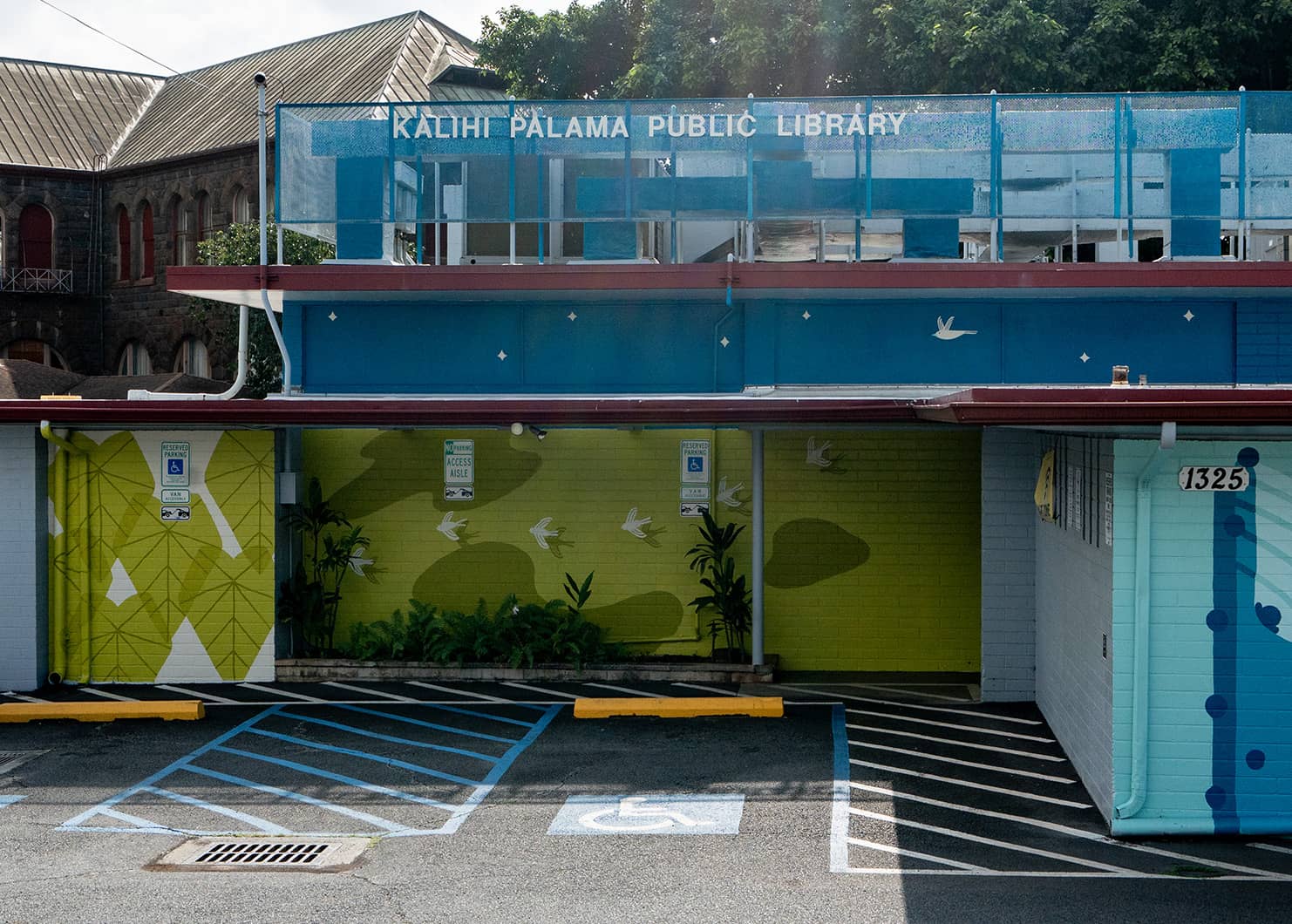
Kalo was not only a crop found where the Kalihi-Pālama Library is located, but also served as sustenance for the Hawaiians.
Kalihi Valley
The manu o kū guided the navigators to land. The overhead view of the birds are shown flying over Kalihi Valley.
Migration
Humpback Whales
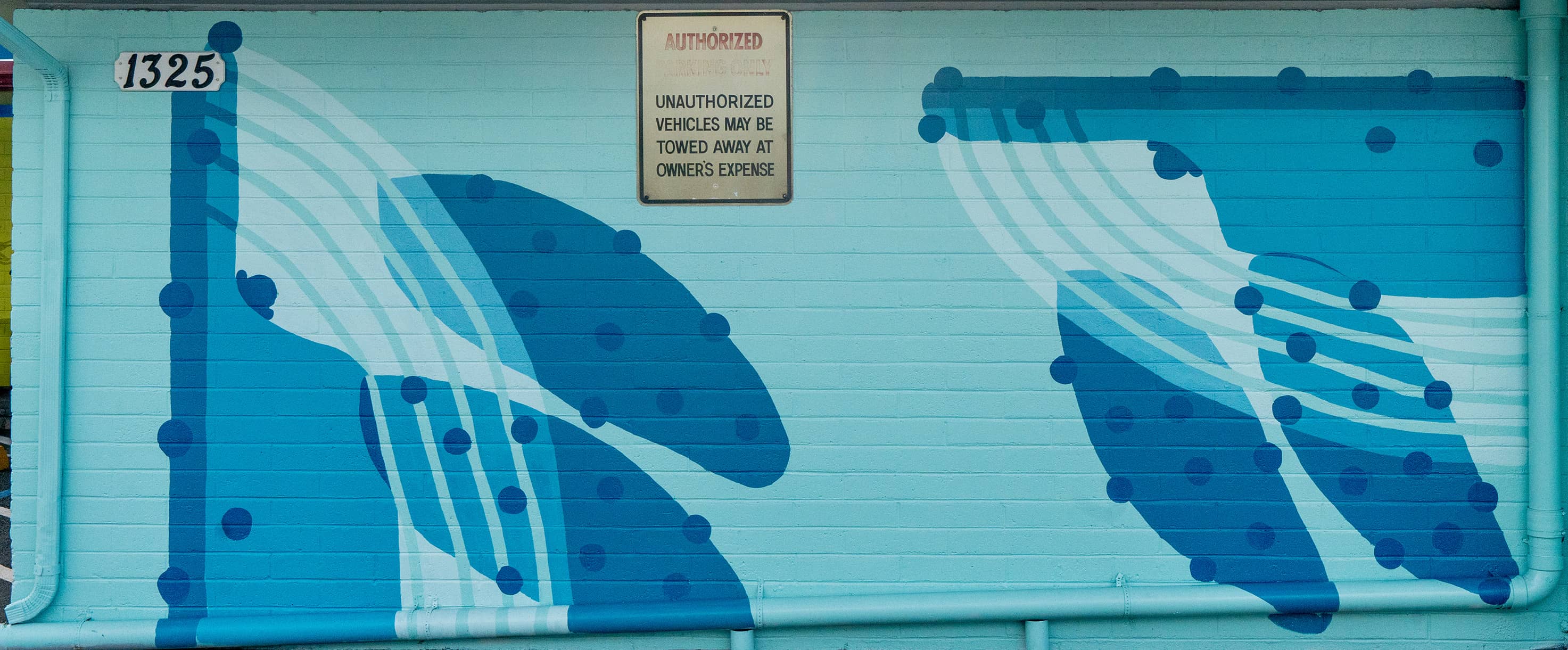
Hawaiʻi’s warm waters are the humpback whale’s home for the winter. Hawaiʻi provides a protected environment for them to breed and birth. It creates a safe space for the calves to learn survival skills away from predators. Similarly to Hawaiʻi, many families continue to migrate here to provide a safe protected environment to raise their children.
Florals & Foliage
Hibiscus
The red hibiscus is a part of Samoan culture, specfically worn by women in their hair as a sign of pride and connection to heritage.
Breadfruit
Breadfruit is a major staple food and culturally significant plant in the Marshall Islands, used in over 20 recipes and processed in various ways for both food and other resources.
Cowrie
Cowrie shells symbolize wealth, prosperity, and protection and often used in Micronesian jewelry.
Birds
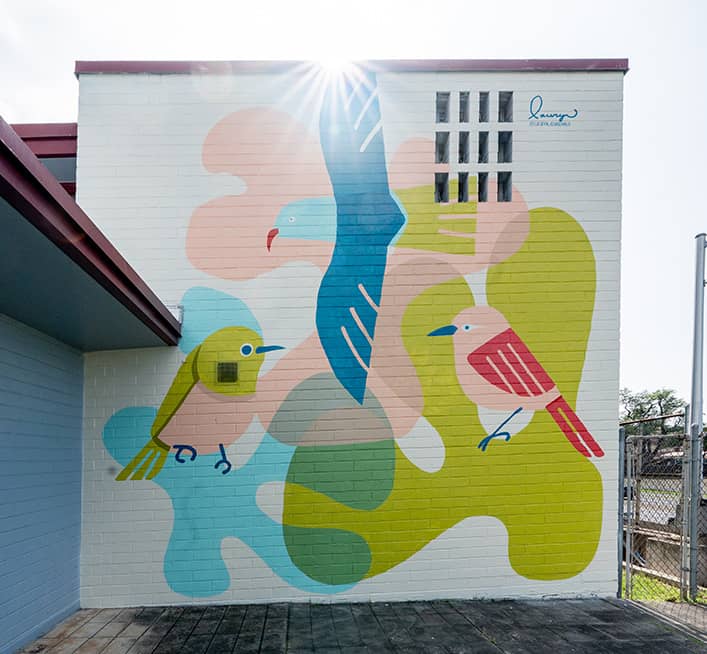
The coral serves as a backdrop to the connection between the many cultures that make up Hawaiʻi’s vibrant community. Birds are a symbol of freedom. They are also the carriers of new plant species. These two ideas marry the concept of migrating for new opportunities bringing some sense of comfort from home.
Warbling White Eye (Mejiro)
The warbling white eye, found in Hawaii, is a native bird to Japan. It was historically kept as a cage bird, but in Hawaiʻi roams free.
Chinese Hwamei
The hwamei, or melodious laughing-thrush, is originally from central China. First released on Oʻahu as escapees during a fire. They were then purposefully introduced to the other islands. A secretive brown forest bird with a white eye-line, it is rarely seen but conspicuous by its long melodic song.
Band-rumped storm petrel (ʻAkēʻakē)
The band-rumped storm petrel is an endangered seabird found in Hawaiʻi and Portugal. The seabird is known for traveling long distances across the ocean.
White Tern (Manu o Kū)
Manu-o-Kū means “Bird of Kū” in Hawaiian. Kū is the god of war in Hawaiian mythology and is represented by images of a feathered god. Some linguists believe the manu-o-Kū name was derived from “ohu”, the Hawaiian word for fog, mist or cloud. Manu-o-Kū are known by traditional Hawaiian navigators as one of the best indicators of land. Seafarers use manu-o-Kū to aid in navigation because they generally will fly out to sea in the morning to feed and then return to land at night. By going the direction the birds are coming from in the morning and following them at night, navigators will likely reach land. Even though terns may travel hundreds of miles, the presence of these birds in the vast Pacific Ocean can assure wayfinders that they are near land. (credit: Hui Manu-o-Kū)
While I was painting, each challenge I faced reminded me of my exploration into the world of migrating my artwork from something solely for myself to these opportunities I get to share with everyone. My specific project hurdles are no where near what immigrant communities face when migrating to a new home, but it did serve as an opportunity to look inward within myself and push harder.